
Nabow is a One-Stop Destination for All the Latest and Greatest in the World of Technology News and Innovations.
⎯ 《 Nabow • Com 》
Chinese cities brace for floods as heat scorches inland regions
By Ryan Woo and Liz Lee BEIJING (Reuters) -Beijing and other cities braced for severe flooding on Friday as summer
2023-07-21 16:57
Scientists find six planet system where stars orbit in rhythmic beat
Astronomers have found a planetary system with six different worlds that orbit in a strange rhythm. The set of planets move around their star in a rhythmic beat, scientists say, staying synchronised in a kind of dance. The findings could help shed more light on how planets form and evolve, the researchers say. The star is smaller, and slightly dimmer than the Sun, and the six “sub-Neptunes” - possibly smaller versions of Neptune in our solar system - move in a cyclic rhythm. According to the experts, this orbital waltz repeats itself so precisely it can be readily set to music. The star, HD110067, is 100 light-years away in the northern constellation of Coma Berenices, and had perplexed researchers for years. Now scientists, including those at the University of Warwick, have revealed the true architecture of this unusual system using Nasa and European Space Agency (Esa) spacecraft. The analysis was led by University of Chicago scientist Dr Rafael Luque, who said: “This discovery is going to become a benchmark system to study how sub-Neptunes, the most common type of planets outside of the solar system, form, evolve, what are they made of, and if they possess the right conditions to support the existence of liquid water in their surfaces.” The first indication of planets orbiting the strange star system came in 2020, when Nasa’s Transiting Exoplanet Survey Satellite (Tess) detected dips in the star’s brightness which suggested planets were passing in between the star and the spacecraft. A preliminary analysis revealed two possible planets - one with a year (the length of time it takes to complete one orbit around the star) of 5.64 days, and another with an unknown period at the time. Two years later, Tess observed the same star again, and analysis ruled out the original interpretation but presented two additional possible planets. Much was still unknown about the planetary system, until scientists across the world - including those at the University of Warwick - joined the investigation. They used data from Esa’s Characterising Exoplanet Satellite (Cheops), hoping to determine the orbital periods of these faraway planets. While multi-planet systems are common in the Milky Way, those in a tight gravitational formation known as “resonance” are observed by astronomers far less often. In this case, the planet closest to the star makes three orbits for every two of the next planet out - called a 3/2 resonance - a pattern that is repeated among the four closest planets. Among the outermost planets, a pattern of four orbits for every three of the next planet out (a 4/3 resonance) is repeated twice. Thomas Wilson, from the Department of Physics at the University of Warwick, said: “By establishing this pattern of planet orbits, we were able to predict other orbits of planets we hadn’t yet detected. “From this we lined up previously unexplained dips in starlight observed by Cheops and discovered three additional planets with longer orbits. This was only possible with the crucial Cheops data.” Researchers say the planets - two to three times the size of Earth - are likely to have been performing this same rhythmic dance since the system formed billions of years ago. Dr Luque said: “We think only about 1% of all systems stay in resonance, and even fewer show a chain of planets in such configuration.” Experts say orbitally resonant systems are extremely important to find because they tell astronomers about the formation and subsequent evolution of the planetary system. Planets around stars tend to form in resonance but can easily have their orbits thrown around. For example, a very massive planet, a close encounter with a passing star, or a giant impact event can all disrupt the careful balance. Therefore, multi-planet systems preserving their resonance are rare. HD110067 is the brightest known system with four or more planets. Since those planets are all sub-Neptune-sized with likely larger atmospheres, it makes them ideal candidates for studying using the James Webb Space Telescope (JWST) and the Esa’s future Ariel telescope. Mr Wilson added: “All of these planets have large atmospheres - similar to Uranus or Neptune - which makes them perfect for observation with JWST. “It would be fascinating to test if these planets are rocky like Earth or Venus but with larger atmospheres - solid surfaces potentially with water. “However, they are all much hotter than Earth - 170C to 530C - which would make it very difficult for life to exist.” Hannah Osborne, a PhD student at UCL’s Mullard Space Science Laboratory and a co-author of the study, said: “The system itself is a key discovery for exoplanet science: because all six planets are in a resonant chain we know that the architecture of the system can’t have changed much since its formation, so by studying HD110067 we get a rare window into the past to understand how these types of systems may have formed and evolved.” The findings are published in the Nature journal. Additional reporting by Press Association Read More Astronomers find unprecedented ‘disc’ around distant planet Astronomers discover new six-planet system Scientists have cooked ‘alien haze’ that could help find life Astronomers find unprecedented ‘disc’ around distant planet Astronomers discover new six-planet system Scientists have cooked ‘alien haze’ that could help find life
2023-11-30 00:15
F1 23 Miami Setup: Best Race Settings
Here's the best F1 23 Miami setup for a race victory in Florida, including tyre pressure, brake bias, and aerodynamic settings.
2023-06-16 03:20
Hitman: Blood Money is coming to mobile and Nintendo Switch
'Hitman: Blood Money - Reprisal' is coming to mobile and Nintendo Switch.
2023-10-05 19:53
Shipping Regulator Falls Short of 1.5C-Aligned Climate Goals
Shipping’s international regulator set non-binding emissions goals that fail to align with restricting global warming to 1.5 degrees
2023-07-08 00:17
Kyoto Semiconductor Announces 14 Reflective Sensor Products Using Near-Infrared Light
SHIMOTSUKE-SHI, Japan--(BUSINESS WIRE)--Jun 27, 2023--
2023-06-27 12:20
Unblock Hulu for free with this simple hack
SAVE 49%: Access your Hulu subscription from anywhere in the world with ExpressVPN. A one-year
2023-08-03 12:16
Apple's WWDC 2023: How to Watch and What to Expect
Apple is hosting its annual Worldwide Developers Conference (WWDC) on Monday, and like Microsoft’s Build,
2023-06-05 12:18
Solar panel world record smashed with ‘miracle material’
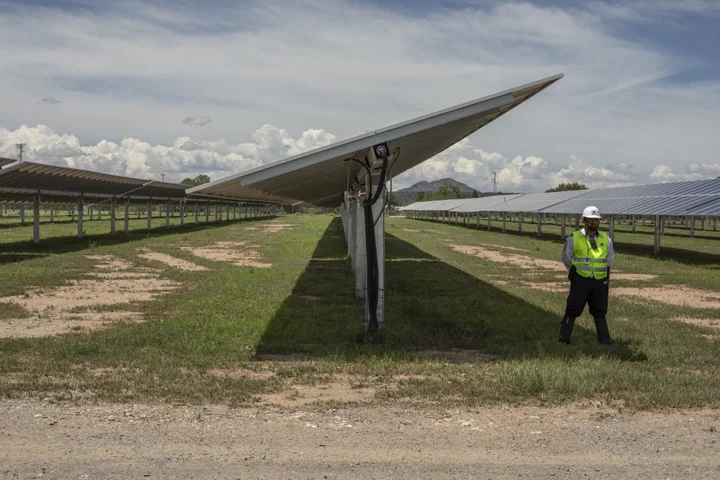
Researchers have made a breakthrough with a so-called miracle material to break the efficiency record for solar panel electricity generation. A team from the Chinese solar technology firm Longi set a new world record of 33.9 per cent for a silicon-perovskite tandem solar cell, breaking the previous record set in May this year by King Abdullah University of Science & Technology (KAUST) in Saudi Arabia. The new efficiency record also broke the theoretical limit of 33.7 per cent for the first time of standard single junction cells, which are found in commercial solar panels. “This provides meaningful empirical data to demonstrate the advantage of crystalline silicon-perovskite tandem solar cells over crystalline silicon single junction solar cells in terms of efficiency,” the company noted in a statement. “The emergence of crystalline silicon-perovskite tandem technology has opened up a new track for the development of next-generation high-efficiency solar cell technology. This means that the same area, absorbing the same light, can emit more electricity.” The theoretical efficiency limit of silicon-perovskite tandem solar cells is 43 per cent, however this level is unlikely to ever be realised on a commercial scale. The first production of ultra-efficient perovskite solar panels could begin in China, with researchers from Nanjing University saying earlier this year that a design breakthrough has made mass production possible. According to the researchers, the next-generation panels will be 50 per cent cheaper and 50 per cent more efficient than traditional silicon cells, however the efficiency rates will still be a long way off the levels achieved in the lab. UK startup Oxford PV, which is a spin-out from the University of Oxford, is already in the process of commercialising the technology, with hopes of beginning full-scale production at a German facility later this year. “Current silicon solar panels have reached their physical limits. We’ve got a way to transform the efficiency of these solar cells with perovskite,” Chris Case, Oxford PV’s chief technology officer, told The Independent in August. “The biggest challenge by far is durability and reliability. We already have great efficiency – much greater than current silicon cells – so most of our research and development is spent enhancing reliability, not efficiency.” Perovskite has been hailed as a “miracle material” for its potential to revolutionise everything from high-speed telecommunications to renewable energy technologies. Its potential for solar panels is not limited to the efficiency gains compared to traditional silicon cells, but also new ways of using them. Recent breakthroughs include self-healing solar panels that can maintain their efficiency for tens to hundreds of years, as well as double-sided solar panels capable of generating electricity from the Sun’s energy on both sides. The material could also be used in applications ranging from building-integrated solar panels to space-based electricity generation. Read More How tech could turn our homes into renewable energy power stations Hundreds of years after it was discovered, one material is about to change the world Millions could abandon electrical grid with new solar panel advance Millions of Australians left without mobile and internet network after Optus outage Guidance urges parents not to buy smartphones for primary school children
2023-11-08 19:23
US takes on Google in much-anticipated antitrust trial
By Diane Bartz WASHINGTON (Reuters) -The United States argued on Tuesday that Google did not play by the rules in
2023-09-12 21:52
Giant alien-like virus structures with arms and tails found in the US
If there’s one thing the Covid pandemic taught us, it’s that viruses shouldn’t be underestimated. People are, therefore, taking note after scientists discovered a whole new range of giant virus-like particles (VLP) that have taken on “previously unimaginable shapes and forms.” The microscopic agents, resembling everything from stars to monsters, were found in just a few handfuls of forest soil. The sample was collected from Harvard Forest, near Boston in the US back in 2019, and flown over to Germany’s Max Planck Institute. Sign up for our free Indy100 weekly newsletter There, its contents were carefully examined and, at the end of last month, the findings were finally released. The team of researchers behind the investigation said that their discoveries “question our current understanding of the virosphere” and “imply that giant viruses employ a much wider array of [...] structures and mechanisms to interact with their host cells than is currently known.” In other words, the results prove how little we actually know about the universe of viruses that exist here on Earth. They also noted that the origins and functions of the different viral structures they found remain unknown – so there’s still plenty of mystery left to solve. The team at the Max Planck Institute, led by Dr Matthias Fischer, were amazed to find “an astounding diversity of virus-like particles (VLP)," in such a small sample. "Amazingly, we found that a few hundred grams of forest soil contained a greater diversity [of the structures] than that of all hitherto isolated giant viruses combined," they wrote. These included one type that resembled a supernova: Another that the teamed named the “haircut”: Another called the “turtle” morphotype: Another christened the “Christmas star”: And another called the “Gorgon” – named after the sisters with snakes for hair from Greek mythology: To clarify, VLP are molecules that closely resemble viruses, but they differ from them in one crucial way: they are non-infectious. This is because they contain no viral genetic material. Still, as virus-host systems, they are key to better understanding their potentially noxious counterparts. “[Our] findings imply that giant viruses employ a much wider array of [...] structures and mechanisms to interact with their host cells than is currently known,” the authors wrote. They ended their paper: “This fascinating window into the complex world of soil viruses leaves little doubt that the high genetic diversity of giant viruses is matched by diverse and previously unimaginable particle structures, whose origins and functions remain to be studied.” Clearly, there’s still plenty of work to be done. Have your say in our news democracy. Click the upvote icon at the top of the page to help raise this article through the indy100 rankings.
2023-08-01 15:57
Paige Spiranac trolls Adam Hadwin being manhandled by security at RBC Canadian Open with hilarious meme
Paige Spiranac's recent post revealed that she is not only a golf pro but is also great at making fans laugh
2023-06-14 16:20