

Adults over 65 admit they’re baffled by digital terms including ‘smartphone’
Do you know your phishing from malware? One in six older adults admit they are completely “baffled” by digital terms. A study of 2,000 over-65s found the likes of hyperlinks, phishing and “The Cloud” are among the jargon which leaves people scratching their heads. Processor, malware and USB-C also made the top 20 list of confusing terms - with cookies, IP addresses and smishing also featuring highly. It also emerged 11 per cent think digital terms are so complicated that a foreign language would be easier to learn. To help older people get a better understanding of online jargon, BT Group has partnered with AbilityNet and lexicographer Susie Dent, to create a Digital Dictionary consisting of the 21 most commonly misunderstood words used on the internet. Susie said: “Whilst so much of modern life seems easier online – whether that’s booking a doctor’s appointment, managing your finances, or doing the weekly shop – we’re forgetting one crucial thing: it’s only easier if you understand the language the web is built on. “So, it’s great that this Digital Dictionary is a guide that simplifies the language.” The survey also found the over-65s spend just five and a half hours a week online, with 78 per cent feeling left behind by their lack of knowledge. Just over half (54 per cent) wish they were more knowledgeable when it comes to computing, but 17 per cent of these feel a lack of motivation. Other issues include feeling there is simply too much to learn or needing someone to show them what to do. But 16 per cent worry others will see them as a burden if they ask for help understanding different areas of technology. The main feeling for people who struggle with online jargon is frustration, though others feel silly, or stupid. And while easy access to information (31 per cent), convenience (17 per cent) and keeping in touch with friends and family (15 per cent) were deemed good things about the online world, many had negative things to say. A third (34 per cent) say their least-liked thing about being online is scams, with 14 per cent having privacy concerns. One in 10 (10 per cent) also stress that not every piece of information they see online is credible, according to the OnePoll.com figures. Victoria Johnson, spokesperson for BT Group added: “As younger generations grow up with the internet, it gets even harder for older generations to understand ever-changing online jargon. “But for anyone who isn’t a digital native and didn’t grow up with smartphones or super-fast broadband, it can feel like a whole new world to some. “It’s a shame to see from the research that older adults feel they are a burden when asking for help navigating their way online. “We want to create a more inclusive society by helping them make the most of life in the digital world. “We hope that the variety of online guides will give people the confidence to start exploring the internet and will give them all the training and support needed to live life to the full in the digital age.” The Jargon over 65s don’t understand: 1. Smishing 2. Vishing 3. Hyperlink 4. USB-C 5. Ransomware 6. URL 7. Phishing 8. QR code 9. Cloud 10. Malware 11. IP address 12. Cookies 13. Streaming 14. Tabs 15. Processor 16. Spam 17. Antivirus 18. Hardware 19. Browser 20. Upload 21. USB 22. Social media 23. Emoji 24. Webpage 25. App 26. Google 27. Download 28. Search Engine 29. Software 30. Smartphone Read More Brits think investing is for the super-rich, poll finds Brits get itchy feet in their home after five years, study finds The AI scams that are targeting young adults Elon Musk to live stream himself gaming on X in ‘everything app’ bid Japan startup unveils 15-foot robot suit for space exploration Apple blames Instagram for overheating iPhones
2023-10-02 22:49
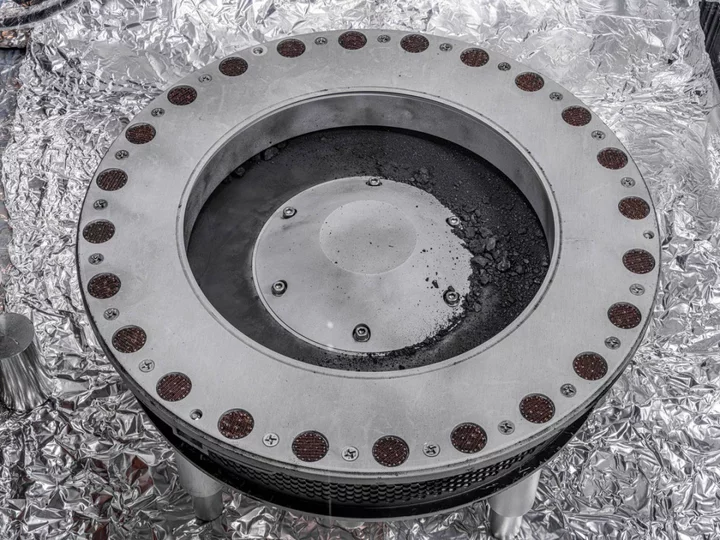
Nasa opens up pieces of a distant asteroid transported back to Earth
Nasa has revealed chunks of a distant asteroid that were transported back down to Earth. The dark, dusty sample comes from a 4.5-billion-year-old asteroid, and might include the “building blocks of life”, the space agency said. Already, the material from the asteroid Bennu has been found to include high-carbon content and water, the space agency said. But it will be distributed around the world with a view to finding out everything from the history of our solar system to how life came about. Scientists and space agency leaders showed photos and video of the asteroid material - returned to Earth last month - at a live streamed event at the Johnson Space Centre in Houston, Texas. The display came after a capsule containing an estimated 250g of rocks and dust collected from asteroid Bennu, touched down in the Utah desert near Salt Lake City on September 24. Nasa has said it was “the biggest, carbon-rich asteroid sample ever delivered to Earth”, and its contents have now been hailed as “scientific treasure”. Nasa administrator Bill Nelson said the sample will “help scientists investigate the origins of life on our own planet for generations to come”. He added: “Almost everything we do at Nasa seeks to answer questions about who we are and where we come from. “Nasa missions like Osiris-Rex will improve our understanding of asteroids that could threaten Earth while giving us a glimpse into what lies beyond. “The sample has made it back to Earth, but there is still so much science to come - science like we’ve never seen before.” Almost 60 million miles away, asteroid Bennu is a 4.5-billion-year-old remnant of our early solar system and scientists believe it can help shed light on how planets formed and evolved. The spacecraft launched on September 8 2016 and arrived at Bennu in December 2018. It dropped the samples off sealed in a capsule last month. “Already this is scientific treasure,” said the mission’s lead scientist, Professor Dante Lauretta, of the University of Arizona on Wednesday. In a statement, he added: “As we peer into the ancient secrets preserved within the dust and rocks of asteroid Bennu, we are unlocking a time capsule that offers us profound insights into the origins of our solar system. “The bounty of carbon-rich material and the abundant presence of water-bearing clay minerals are just the tip of the cosmic iceberg. “These discoveries, made possible through years of dedicated collaboration and cutting-edge science, propel us on a journey to understand not only our celestial neighbourhood but also the potential for life’s beginnings. “With each revelation from Bennu, we draw closer to unravelling the mysteries of our cosmic heritage.” Nasa‘s mission goal was to collect was 60 grams of asteroid sample. But when the canister lid was opened, Nasa said scientists discovered “bonus material” covering the outside of the collector head, canister lid, and base. There was so much extra material it slowed down the process of collecting and containing the primary sample, Nasa said. Scientists are not sure exactly how much of Bennu they brought back because the main sample chamber has not yet been opened. Mr Lauretta said: “It’s been going slow and meticulous, but the science is already starting.” He said there is “a whole treasure chest of extraterrestrial material” still to be examined. During Wednesday’s press conference, Osiris-Rex sample analyst Daniel Glavin added: “This stuff is an astrobiologist’s dream, I just can’t wait to get at it. “We’re going to learn so much about the origin of the solar system, the evolution and potentially how even life started here on Earth.” Additional reporting by agencies Read More ‘Ring of fire’ solar eclipse this month will be last until 2046 Prada to design Nasa’s next-gen space suits for Artemis astronauts 1.2 mile-high ‘dust devil’ spotted on Mars by Nasa’s Perseverance rover Rover captures one-mile-high whirlwind on Mars Earth hit by a huge solar storm that would devastate civilisation, trees show Scientists see afterglow from huge planets crashing into each other for first time
2023-10-12 20:19
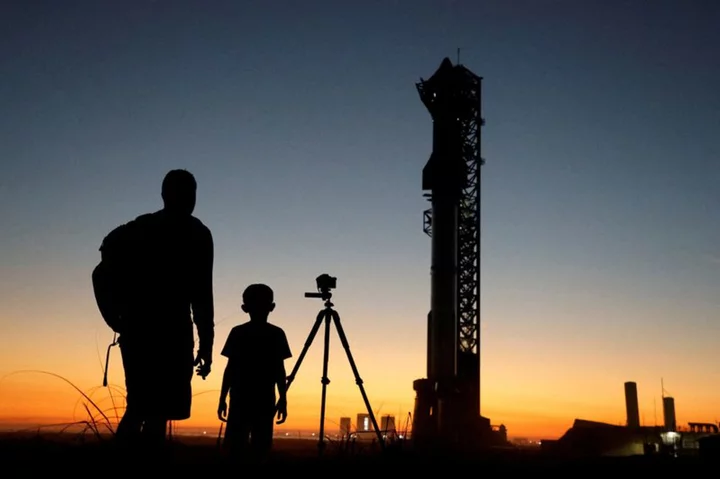
SpaceX Starship launched on test flight in Texas after last one blew up
By Joe Skipper, Joey Roulette and Steve Gorman BOCA CHICA, Texas (Reuters) -SpaceX's uncrewed spacecraft Starship, developed to carry astronauts
2023-11-18 21:53

'Record' ocean temps lift Atlantic hurricane outlook
(Reuters) -Forecasters at Colorado State University for a second time raised their estimate for storms during this year's Atlantic hurricane
2023-07-07 00:23

Prime Day Deals so good, they're literally free
There's a big downside to Prime Day deals: even when you spot a great bargain,
2023-07-13 07:24

Rare 'ocean' planet found that is twice the size of Earth
A rare planet has been discovered hundreds of light years away, and it could prove key to our understanding of planetary formations out there in the universe. There have been more than 5,300 exoplanets discovered, but few match the description of the newly recorded TOI-733b. Found 245 light-years away, TOI-733b is almost twice the size of Earth and orbits a sun slightly smaller than our Sun. While there are many exoplanets, there are a surprisingly small number which sit between one and a half and two times the radius of the Earth, and it's the size that makes it so interesting to scientists. Sign up to our new free Indy100 weekly newsletter The research was conducted by a team of astronomers led by Iskra Georgieva of Chalmers University of Technology in Sweden. It was accepted for publication in Astronomy & Astrophysics. The team focused on TOI-733b after data on the planet was collected by NASA's telescope TESS. The density of the planet suggests two things – it’s either totally covered in water, or it’s lost its atmosphere altogether. Clues point to the idea of TOI-733b’s atmosphere slowly depleting. That’s due to the proximity of the planet to its star, which it orbits in the space of just 4.9 days. If the atmosphere is being burned away, it means it could soon be transformed into a rock planet. The other possibility points to the planet having lost its hydrogen and helium, while retaining an atmosphere packed with water vapour. "Answering the question of whether TOI-733b has a secondary atmosphere or is an ocean planet boils down to differentiating between a Neptune-like planet that lost its ∼10 per cent of H/He to leave behind a steam atmosphere of heavier volatiles, and one that formed and remained relatively the same throughout its evolution," the research reads. "While being beyond the scope of this paper, finding an answer to this question will have broad implications on our understanding of exoplanets." The team went on to write: "By all accounts TOI-733 b looks to be an interesting planet and holds the potential of being a small but key piece to solving big puzzles in exoplanet science. "With ever increasing in-depth theoretical analyses and the promise of high-precision follow up by present and upcoming facilities, we seem to be well on the way to finding answers to major questions relating to planet formation and evolution." Have your say in our news democracy. Click the upvote icon at the top of the page to help raise this article through the indy100 rankings.
2023-05-15 01:17

Apollo app to shut down as Reddit API dispute somehow gets uglier
Reddit's most popular third-party app, Apollo, will shut down due to new API fees Reddit's
2023-06-09 06:25

‘Billions’ of Intel computers potentially affect by huge security vulnerability
A major security vulnerability had the potential to hit “billions” of computers, according to the Google researchers who discovered it. The security flaw, dubbed “Downfall”, attacked Intel processors in a way that would allow hackers to steal passwords, encryption keys and private data from users. That’s according to Daniel Moghimi, the senior research scientist at Google who found the problem and disclosed it this week. He alerted Intel about the issue with its chips, and the company has since sent out an update to fix it. But the issue could have affected “billions of personal and cloud computers”, Google said. “Had these vulnerabilities not been discovered by Google researchers, and instead by adversaries, they would have enabled attackers to compromise Internet users,” the researchers wrote in a blog post. The attack worked by breaking through the boundary that is intended to keep software safe from attacks on the hardware. In doing so, attackers would have been able to find data that belongs to other users on the system, the attackers said. It did so by exploiting technologies that are intended to speed up various processes on the chip. Attackers were able to exploit those tools to steal sensitive information that should have stayed available only to its owner, when they were signed in. The nature of the attack means that hackers would need to be on the same physical processor as the person they are attacking. But that would be possible using malware, or the shared computing model that powers cloud computing, for instance. Intel said that the problem does not affect recent versions of its chips, and that the fix does not cause major problems. But it did suggest that users could disable the fix, if they thought the risk was not worth the slight drawbacks in performance. The company also told Bleeping Computer that “trying to exploit this outside of a controlled lab environment would be a complex undertaking”. Read More AI breakthrough could dramatically reduce planes’ global warming impact Earth hit by powerful ‘X-1’ solar flare, after fears of ‘cannibal’ blast Even Zoom wants staff to ‘come back to the office’
2023-08-10 00:48
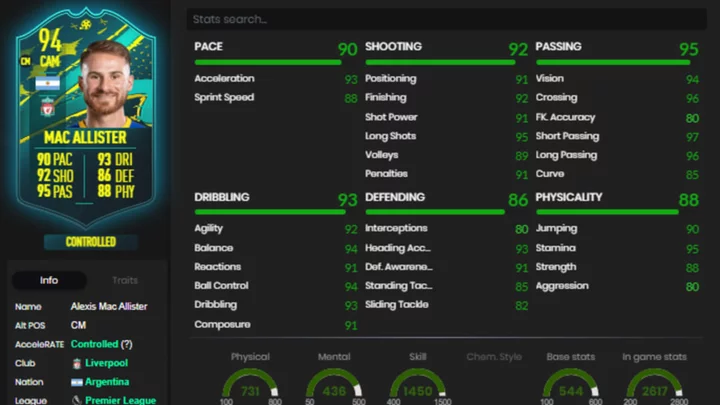
Alexis Mac Allister FIFA 23: How to Complete the Moments SBC
Alexis Mac Allister FIFA 23 Moments SBC celebrates his summer transfer move to Liverpool. Here's how to get Alexis Mac Allister's first ever Liverpool card in FIFA Ultimate Team.
2023-07-13 01:20

ChatGPT creator signs up for eyeball-scanning cryptocurrency
OpenAI boss Sam Altman has finally signed up for his own Worldcoin cryptocurrency, four years after founding the controversial venture. The tech boss, whose AI startup created ChatGPT, recently raised $100 million to finance his crypto side project, which involves scanning millions of people’s eyeballs in order to trade their biometric data for free cryptocurrency. Until this week he had been unable to join the project due to it being unavailable in his native US. On a trip to Europe on Tuesday, where the technology is not restricted, Mr Altman signed up to the venture through a silver orb that uses iris scanning technology to capture user data. This data is used to verify an individual’s “unique personhood”, which entitles them to a free share of Worldcoin tokens when it officially launches. More than 1.5 million people have already signed up for the project, according to the company’s own figures, with the launch expected to take place in the coming weeks. The company describes the cryptocurrency as a “new, collectively owned global currency that will be distributed fairly to as many people as possible”, claiming that everyone in the world is eligible for a free share of it. The Worldcoin tokens, called WLD, is similar to other cryptocurrencies in that it can be used as a store of value or to make payments, with the project’s website stating that it can be used for “remittances, [to] tip artists, [and] buy and sell goods and services”. Worldcoin has generated controversy for collecting biometric data from people in developing countries in exchange for free gifts and cash, but the company claims this unique approach to crypto means it can be distributed fairly and inclusively After scanning a person’s iris with the spherical device, which the company calls the “chrome orb”, a user is given their allotted share of Worldcoin. This means no one is able to get more than their individual free share of the digital currency, though it will still possible to buy and trade it separately, just like any other cryptocurrency. “Nothing like this has ever been done before and the outcome is uncertain,” Mr Altman wrote in a blog post in 2021, alongside other Worldcoin co-founders. “But we are obsessed with the idea that revolutionary new technologies like blockchain and cryptography can let us do something collectively that even governments have not been able to: increase individual empowerment and equality of opportunity on a global scale.” Read More What is superintelligence? How AI could replace humans as the dominant lifeform on Earth
2023-05-25 03:46
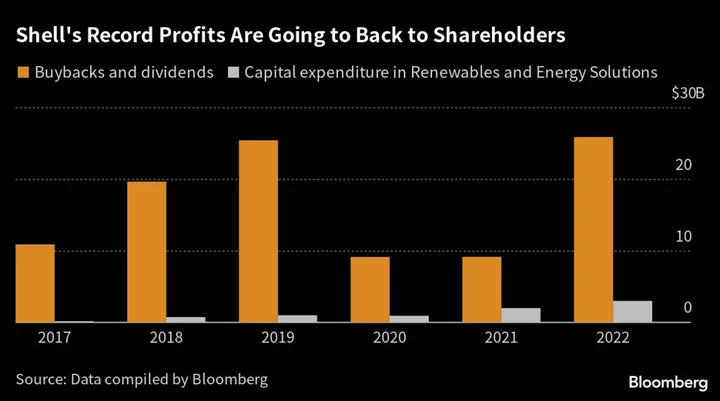
Shell Demands Profit From Green Energy, Not Just CO2 Cuts
Shell Plc executives are telling their renewable power business that it needs to become more profitable, not just
2023-05-18 20:58

Hytera Mission-critical Push-to-talk Solution Wins Flagship Industry Award
HELSINKI--(BUSINESS WIRE)--May 25, 2023--
2023-05-25 23:50
You Might Like...

AI Hype Starting to ‘Smell Like Dot-Com Era,’ ESG Veteran Says

BigCommerce Scores 24/24 Total Medals in 2023 Paradigm B2B Combine Midmarket and Enterprise Editions
Nvidia shorts down $4.1 billion in mark-to-market losses since May 24-S3 Partners

Mintra Inks Strategic Partnership With ARuVR to Transform Learning Across Maritime, Energy and Safety-Critical Sectors

Transcend named as a Major Player in the IDC MarketScape Data Privacy Compliance Software 2023 Assessment

Apex Legends Loba Prestige Skin and Finisher Leaked

Sapphire Ventures plans to invest over $1 billion in enterprise AI startups

PewDiePie: From Pokimane to Justin Bieber, YouTuber rates celebrity houses